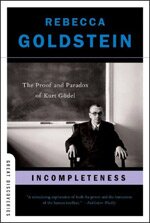
Rebecca Goldstein, Incompleteness: The Proof and Paradox of Kurt Gödel (New York: W. W. Norton & Company, 2005) 296pp.
by Sonya L. Wilson
Incompleteness-The Proof and Paradox of Kurt Gödel by Rebecca Goldstein tells the story of Kurt Gödel, one of the greatest mathematicians and logicians of modern times. Gödel’s theorem suggesting that all mathematical truths or, for that matter, logic, cannot be known, defined or proved, rocked the scientific community of the 20 th century and the theorem significantly challenged all modern thought.
The author of Incompleteness, Rebecca Goldstein, has taught philosophy at various top U.S. universities. She is also the author of eight books. Incompleteness is a nonfiction account of Gödel’s life and accomplishments. The book portrays a man of great, albeit tortured, genius.
Goldstein opens the book not by focusing on Gödel’s revolutionary theorems but by exploring his intriguing friendship with Albert Einstein. On the first page we are shown an image of two men walking serenely together, ".hands clasped behind their backs, quietly speaking". As we read on we see that these two men on their daily walk are Albert Einstein and Kurt Gödel. These gentlemen used to take daily walks together at Princeton University . Einstein, the physicist, and Gödel, the mathematician, were in many respects, very different but they understood and respected each other, establishing a warm and close friendship.
The author relates the relationship between the two men to illustrate how they both saw themselves as exiles from their native Austria . Their intellect has greatly impacted human thought and at the same time, this same intellect isolated them from others. With the presentation of the Einstein/Gödel friendship, Goldstein sets up her thesis that those we consider to be "geniuses" have internal struggles with their intellect and may very well be alone and isolated.
The book then takes us through Gödel’s life, from his entrance into the University of Vienna at the age of eighteen to his fascination with Platonism, the invitation to join a group of distinguished philosophers known as Vienna Circle and development of his incompleteness theorems. We are shown how Gödel’s passions not only led him to his groundbreaking work, but also brought him to the brink of madness, which, in turn led to his tragic end.
Incompleteness-The Proof and Paradox of Kurt Gödel may be a daunting read for some but the strength of the work lies in the compelling look into the revolutionary mathematician’s personal side of Gödel and a clear explanation of Gödel’s "incompleteness" theorems.
The general reader may not be able to grasp the concepts of Incompleteness but those knowledgeable in the field of mathematics and philosophy should find this work very informative and enjoyable.
Sonya L. Wilson is a freelance writer and educator in Pennsylvania.